A 3 on 3 off schedule is a popular 12-hour shift rotation used by law enforcement agencies to maintain 24/7 coverage.
In this guide, we’ll walk through a practical 3 on 3 off schedule example, explain how it works, and highlight key considerations for departments evaluating this rotation.
Departments sized 25-35 have a variety of different ways they schedule. We will only cover one in this article. If you're interested in more, check out these schedule examples for departments around 25-35 people!
What is a 3 On 3 Off Schedule?
A 3 on 3 off schedule is a repeating shift pattern where officers work three consecutive 12-hour shifts, followed by three consecutive days off.
This rotation continues in a cycle, allowing agencies to maintain continuous coverage while giving officers regular time off.
Because it follows a predictable pattern, it is often used in patrol environments where consistency and simplicity are important.
How a 3 On 3 Off Schedule Works
In most cases, departments divide staff into squads that rotate through the schedule to ensure full coverage.
A typical setup includes separate teams assigned to day and night shifts, each following the same 3 on 3 off pattern.
To maintain 24/7 operations, agencies typically use multiple squads working staggered schedules. While the exact structure may vary, the goal is to ensure that coverage is continuous without gaps between shifts.
Example: 6-Week 3 On 3 Off Rotation
The 3 on 3 off schedule is often organized into a repeating multi-week cycle.
In a 6-week version of this schedule (as seen below), squads rotate through assigned shifts while maintaining the same on/off pattern. Departments typically create templates that represent either individual officers or entire squads working the same schedule.
These templates help standardize scheduling and make it easier to assign personnel based on staffing needs.
To ensure full coverage, agencies typically operate with multiple squads following complementary schedules.

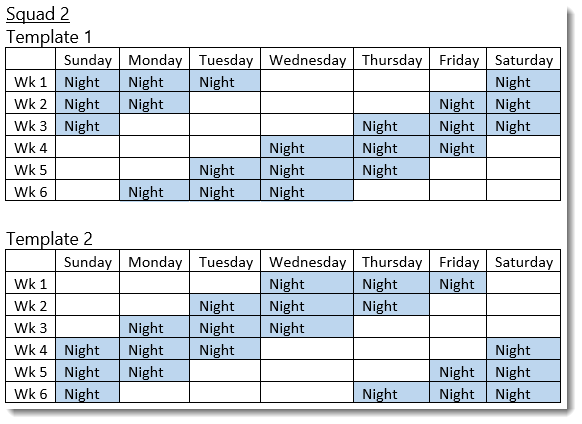
These 4 templates will cover round the clock. Depending on how large your organization is, you may have many people assigned to one template.
Balancing Day and Night Shifts
One challenge with this schedule is ensuring fairness between day and night assignments.
Some departments address this by rotating officers between day and night shifts over a longer cycle, such as a 12-week rotation (as seen below).
For example, officers may work six weeks of night shifts followed by six weeks of day shifts.
While this approach helps distribute shifts more evenly, it can also introduce fatigue as officers adjust their sleep schedules during transitions.
.webp?width=588&height=683&name=12%20week%20-%203%20on%203%20off%20-%2012%20hour%20shifts%20(1).webp)
These templates would require another squad with opposite shift times to cover 24x7. So the first 6 weeks would be night shifts, second 6 weeks would be day shifts.
These schedules may lead to more fatigue because officers will have to adjust their sleep schedules every 6 weeks. However, it will give equal allocation between officers of day and night shifts.
You can extend the weeks out more if you'd like to go a longer period before switching shift times. For example, make 12 weeks of day shifts, 12 weeks of night shift.
This may be a better solution to reduce fatigue but will require some work to set up originally.
Adjusting the Rotation to Fit Your Department
There is no single way to implement a 3 on 3 off schedule.
Departments may extend rotation cycles, adjust shift start times, or modify how squads are assigned based on staffing levels and operational demands.
For example, some agencies choose longer rotations before switching between day and night shifts to reduce fatigue and improve consistency.
The best schedule is one that balances coverage, officer well-being, and administrative simplicity.
Pros and Considerations of a 3 On 3 Off Schedule
One of the main advantages of this schedule is its simplicity. Officers benefit from a predictable pattern and frequent days off, which can support work-life balance.
At the same time, 12-hour shifts can be demanding, particularly in high-call-volume environments. Departments should carefully evaluate how longer shifts may impact fatigue, performance, and overall staffing needs.
Common Questions About 3 On 3 Off Schedules
What is a 3 on 3 off schedule?
It is a shift rotation where employees work three consecutive days followed by three days off, typically using 12-hour shifts to maintain continuous coverage.
Is a 3 on 3 off schedule good for law enforcement?
It can be effective for agencies that need simple, consistent scheduling and want to provide regular time off. However, departments should consider the impact of longer shifts on fatigue and performance.
How many hours do officers work in a 3 on 3 off schedule?
Officers typically work 12-hour shifts, totaling 36 hours over a six-day cycle, though overtime and staffing needs may vary.
Do officers rotate between day and night shifts?
Many departments rotate shifts over time to ensure fairness, though the frequency and structure of rotation can vary widely.
Final Thoughts
A 3 on 3 off schedule can be an effective option for departments looking to simplify scheduling while maintaining consistent coverage.
The key is to evaluate how the schedule fits your staffing levels, operational demands, and the well-being of your officers.
If you’re exploring scheduling options or managing complex rotations, personnel scheduling software like PowerTime can help streamline scheduling, improve visibility, and reduce administrative burden.