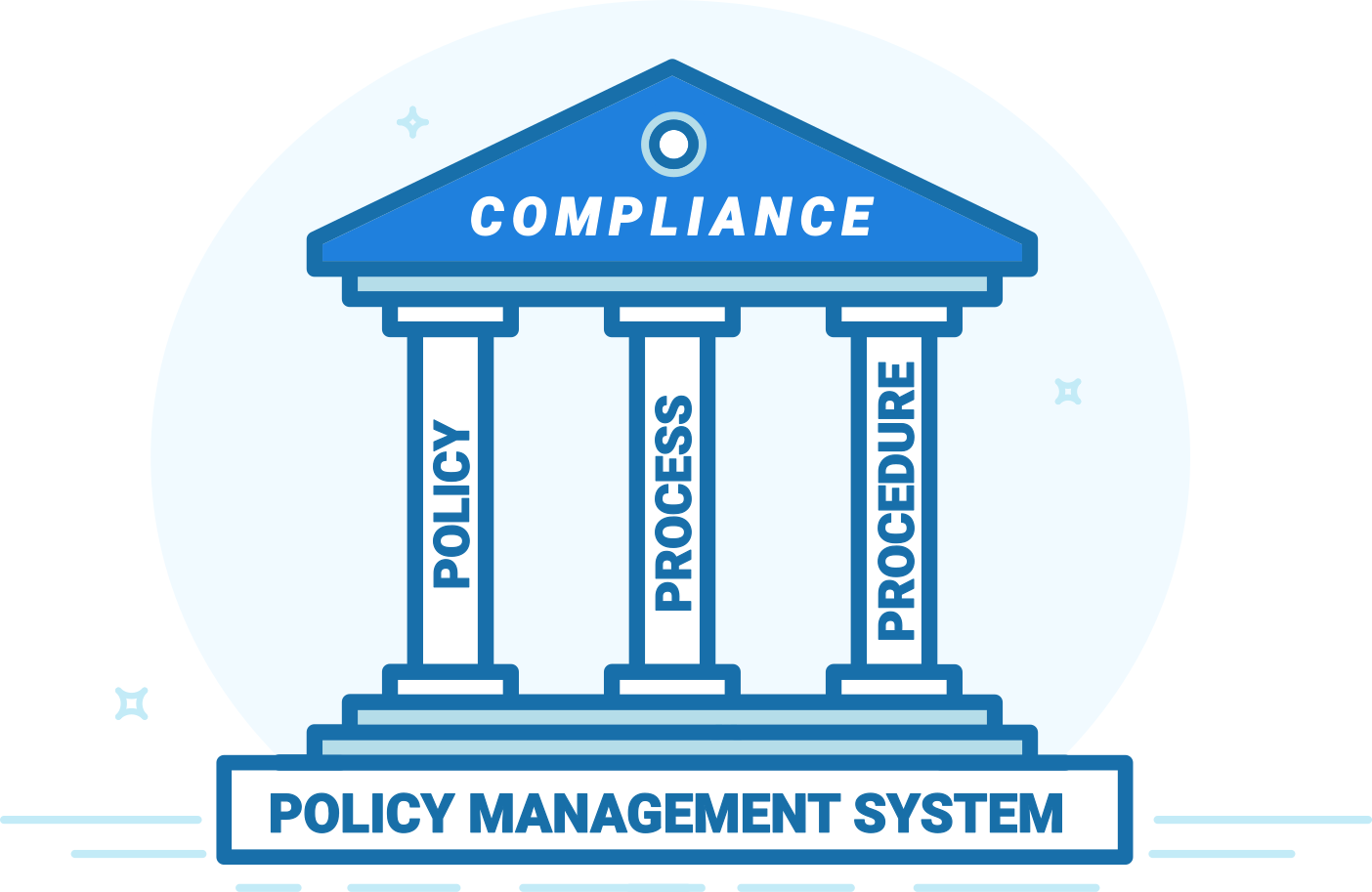
Now that we’ve clarified the difference between policy, process, and procedure, it’s time to look at the tools that help organizations manage them.
Choosing the right policy management software can have a major impact on compliance, efficiency, and accountability. The best platform should do more than simply store documents. It should help your organization create, update, distribute, and track critical content in a way that is easy to manage and easy for employees to use.
There are many tools on the market and some are costly – not just in dollars, but in implementation time, administration, and long-term maintenance. That’s why it’s important to evaluate each option based on both functionality and total cost of ownership.
Broadly speaking, the platforms below fall into three categories: dedicated policy management systems, document management tools, and content-oriented solutions. We’ll discuss those distinctions in more detail later, but first, let’s review a few of the most common options.
Best for: Organizations with strong Microsoft expertise and IT resources
Microsoft SharePoint is best known as a document storage and collaboration platform. Because it is highly customizable, some organizations use it as the foundation for an internal policy management system.
That flexibility can be appealing, especially for organizations already invested in the Microsoft ecosystem. With enough time, technical support, and internal resources, SharePoint can be configured to support document storage, collaboration, and basic policy distribution.
Key Features
As part of Microsoft Office, SharePoint integrates with the entire Office suite, so you can easily use Word, Excel, and PowerPoint. It lets you manage document security, track changes in a limited capacity, and go paperless. SharePoint offers:
- Centralized storage
- Microsoft Office integration
- Collaboration and sharing
- Document security
- Scalable and customizable
- Mobile functionality
Potential Drawbacks
That said, SharePoint is not a purpose-built policy management solution. Out of the box, it has limited functionality for the full policy lifecycle, and most organizations cannot simply purchase it and begin managing policies effectively on day one.
In practice, getting SharePoint to function as a policy management system often requires significant setup, customization, and ongoing support from a developer or IT team.
Another common challenge is that SharePoint environments are often built to meet immediate needs, then gradually become outdated as priorities shift. Updates may depend on IT tickets and development resources, which can delay improvements and make the system harder to adapt over time.
Search can also be a limitation. When employees need to find a policy quickly, especially in high-stakes or regulated environments, limited or inconsistent search functionality can become a real operational issue.
Final Review
SharePoint may be a viable option for organizations that already have strong Microsoft expertise and are comfortable investing in customization and long-term administration. But for many organizations, especially those looking for a faster, more purpose-built solution, SharePoint can become expensive and complex to maintain.
The more customized the system becomes, the more training and support employees may need to use it effectively. So while SharePoint can be made to work, it is often better suited to document management than to full-scale policy and compliance management.
Get a direct comparison between SharePoint Online and PowerDMS, or read up on why you should buy vs. build.
Best for: Mid-to-large orgs already on Microsoft/SharePoint
Ideagen Compliance (formerly ConvergePoint) is an all-in-one compliance management suite built natively on Microsoft 365 SharePoint. Following its acquisition by Ideagen in June 2025, the platform now delivers lifecycle management across four integrated modules: Policy Management, Contract Management, Incident Management, and Conflict of Interest Management.
For organizations already invested in the Microsoft ecosystem, Ideagen Compliance can serve as a way to layer additional structure onto an existing SharePoint environment. Its policy management module is designed to support the full lifecycle of policy creation, review, approval, distribution, and acknowledgment.
The software is designed for mid-size to enterprise organizations, particularly those with more than 250 employees. Smaller organizations may find the platform too complex for their needs.
Key Features
Ideagen Compliance’s policy management solution fills some of the gaps in SharePoint, letting you create, review, approve, distribute, and track policies. The solution comes with three modules: Policy Creation, Policy Library (Distribution), and Policy Acknowledgement. Ideagen Compliance includes:
- Centralized storage
- Custom workflows
- Version control
- Role-based access
- Search and reports
- Microsoft integration
- Expiration notifications
- Real-time dashboards
The platform adds structured workflows, version control, role-based permissions, and reporting capabilities that are not fully available in SharePoint alone. It also includes policy acknowledgment tracking and dashboards to help organizations monitor compliance activity in real time.
Potential Drawbacks
The biggest limitation of Ideagen Compliance is its reliance on SharePoint. Organizations that are not already using SharePoint may find it less appealing, since it depends on that underlying infrastructure to function.
Additionally, because it builds on SharePoint, some of the same challenges can carry over, including complexity, reliance on IT resources, and the need for ongoing configuration and maintenance.
While Ideagen Compliance is designed for larger organizations, that focus can make it less practical for smaller teams that need a more streamlined or out-of-the-box solution.
Final Review
Ideagen Compliance can be a strong option for organizations that are already committed to SharePoint, are highly regulated, and want to enhance compliance capabilities without replacing their existing system.
However, for organizations evaluating policy management software from scratch, it’s worth considering whether extending SharePoint is the best long-term approach – or whether a purpose-built platform might provide greater flexibility, ease of use, and faster implementation.
Best for: Organizations needing cloud document management with broad integrations
Box is cloud-based document management software known for its clean interface and broad integrations. Originally built for small to midsize businesses, it has expanded its capabilities significantly with AI-powered features for larger enterprise environments.
Because Box integrates with a wide range of tools – including Adobe, Slack, Google Workspace, Microsoft 365, and Salesforce – it can fit easily into many existing tech stacks without requiring significant customization.
Key Features
Box for Business extends functionality beyond cloud storage and file-sharing by adding features for synchronization and collaboration. Here are some additional features for your document management and security needs:
- Centralized storage
- Automated workflows
- Unlimited storage (for most plans)
- Per user pricing
- File-sharing & collaboration
- Version history
- App integrations
- Security controls
- AI-powered document summarization and Q&A
- AI-powered data extraction
- AI content classification
AI features are available on Business plans and above.
Beyond basic file storage, Box supports collaboration, version history, workflow automation, and security controls, making it a strong option for organizations looking to centralize and manage documents in the cloud.
Potential Drawbacks
While Box performs well as a document management system, it is not specifically designed for policy and compliance management.
Organizations that need to manage accreditation, track employee training, or connect policies to compliance workflows may find themselves relying on workarounds or additional tools to fill those gaps.
Its mobile functionality supports file access and sharing, but is somewhat limited when it comes to deeper interaction with documents or workflows.
The PCMag review of Box found navigation to be on the slower side with limited online editing functionality. External users are limited to read-only permissions, and you can't edit documents directly in Box. Instead, you have to edit them on your desktop or in Microsoft Word Online.
Final Review
Box is a strong choice for organizations looking for a cloud-based document management solution with broad integrations and scalable pricing options.
However, if your primary goal is to manage policies as part of a larger compliance framework – particularly one that includes training, accreditation, and accountability – Box may not provide the specialized functionality needed without additional systems.
Learn more about Box and other document management systems here.
Best for: Budget-conscious organizations wanting policy and workforce tools
PMAM is a Human Capital Management (HCM) platform that includes policy management as part of a broader suite focused on workforce development. Its core offerings span knowledge integration, policy management, and performance appraisal.
The platform is designed to support both accrediting bodies and organizations preparing for accreditation, making it particularly relevant for teams that need to align policies with compliance and training requirements.
Key Features
Since they outsource their software development overseas, PMAM makes frequent updates to their product. It's also one of the more affordable policy management options available, offering:
- Centralized storage
- Workflow management
- Accreditation and audit
- Version control
- Version comparison
- Revision and approval process
- Testing functionality
- Training management
PMAM offers a range of functionality, including centralized storage, workflow management, accreditation support, version control, and training management. Its inclusion of testing and performance-related features can be especially useful for organizations looking to connect policies with employee development and evaluation.
Potential Drawbacks
PMAM is often positioned as a more cost-effective solution, which can make it appealing for organizations with tighter budgets.
However, some organizations may find that the user experience is less intuitive compared to more modern, purpose-built platforms. This can impact onboarding and day-to-day usability, particularly for teams that need a system that is easy to adopt across a wide range of users.
In addition, the quality and consistency of training resources and customer support can vary. For organizations that rely heavily on guided onboarding or ongoing support, this may be an important factor to evaluate during the decision-making process.
Final Review
PMAM can be a viable option for organizations prioritizing affordability and looking for a platform that combines policy management with broader workforce development capabilities.
However, organizations that place a higher value on ease of use, polished training resources, and consistent support may want to compare PMAM with other solutions before making a final decision.
5. PolicyTech (One Policy & Procedure Management) by NAVEX Global
Best for: Large enterprises with complex compliance needs
NAVEX Global is a well-established provider of governance, risk, and compliance (GRC) solutions, serving a wide range of private sector organizations. Its product suite includes tools for ethics and compliance training, third-party risk management, and policy management.
NAVEX One Policy and Procedure Management – also known as PolicyTech – is NAVEX's cloud-based policy management solution, designed to help organizations centralize policies, support compliance efforts, and manage risk across the enterprise. While you can purchase it independently, it's now positioned as a core component of the broader NAVEX One GRC platform, integrating directly with other enterprise risk modules including ethics hotlines, third-party risk management, and compliance training.
Key Features
NAVEX One Policy and Procedure Management provides centralized storage for policy management. Companies across various industries use it to manage their GRC-related documents and mitigate risk. It also offers:
- Centralized storage
- Workflow automation
- Access control
- Audit-ready reporting
- Policy violations reporting
- Signature tracking
- Microsoft integration
- Mobile functionality
- AI-assisted policy summaries
- AI-powered compliance assistant
The platform includes core functionality such as centralized document storage, workflow automation, access control, acknowledgment tracking, and audit-ready reporting. These capabilities make it a viable option for organizations looking to manage policies within a broader GRC framework.
Potential Drawbacks
While NAVEX One offers a range of compliance-focused features, some organizations find the platform less intuitive than more modern solutions.
Certain limitations in usability and flexibility can impact day-to-day workflows. For example, document comparison functionality is limited, and managing relationships between documents and standards can be less streamlined than expected.
File management can also present challenges. In some cases, moving documents between folders or reorganizing content may require additional steps, which can slow down administrative tasks. Role management is somewhat structured, with predefined roles available, but customization options may be limited depending on your organization’s needs.
As a large, global provider, NAVEX serves a broad customer base. While this brings scale and experience, smaller organizations may find that support and responsiveness vary compared to more specialized vendors.
Final Review
NAVEX One Policy and Procedure Management is best suited for larger organizations that are already investing in a broader GRC strategy and need a policy management solution that fits within that ecosystem.
For enterprise environments with complex compliance requirements, it can provide the structure and reporting needed to manage risk at scale. However, organizations looking for a more flexible, user-friendly solution – particularly in the public sector or highly operational environments – may want to explore alternatives.
If you’re evaluating options, testing the platform through a trial or demo can help determine whether it aligns with your workflow and usability expectations.
Explore this direct comparison between PolicyTech and PowerDMS today.
Best for: Public safety and government agencies needing a comprehensive policy platform
PowerPolicy is purpose-built policy management software designed to connect policies with training, accreditation, field training, and internal affairs investigations – all in a single system.
Built specifically for public safety, PowerDMS now serves over 5,500 law enforcement, fire, EMS, and government agencies with cloud-based solutions focused on compliance, accountability, and operational efficiency.
One of the platform’s key differentiators is its focus on usability and customer support, with a U.S.-based team and high customer satisfaction ratings. This emphasis on support can be especially valuable for organizations navigating complex compliance requirements or transitioning from legacy systems.
Key Features
PowerPolicy allows for policy creation, version control, distribution, attestation tracking, and more. This data is grouped with each respective policy to create a library of living documents. Built with policy managers in mind, it lets you customize admin rights, easily move files between folders, and much more.
While PowerPolicy was built for policy management, it can be used for a variety of content (subpoenas, BOLO's, memos, directives, maps, etc.). Each of the features listed below is supported via online training courses, called PowerDMS University, and training boot camps. With PowerDMS, you get:
- Centralized storage
- Automated workflows
- Signature tracking
- Real-time notifications
- Version control
- Role-based access control
- Complete audit trail
- Powerful search
- Side-by-side comparison
- Integrations (Microsoft Office, OneDrive, Google Drive)
- Mobile functionality
- Public-facing document publishing
- Accreditation management
PowerPolicy supports the full policy lifecycle, including creation, version control, distribution, acknowledgment tracking, and reporting. These capabilities are connected within a centralized system, allowing organizations to manage policies as living documents rather than static files.
The platform also offers workflow automation, role-based access, robust search functionality, and side-by-side document comparison. Its ability to connect policy management with training and accreditation helps organizations maintain alignment across compliance activities.
In addition to traditional policy documents, organizations can manage a wide range of operational content – such as directives, memos, and other critical materials – within the same system.
Potential Drawbacks
PowerDMS is not a content provider, so organizations looking for pre-built policy libraries or out-of-the-box content will need to source that separately. However, integrations and content partnerships are available to help fill that gap, as well as a tool for subscribing to relevant policy content from publishers.
Final Review
PowerDMS is a strong option for organizations looking for a dedicated policy management solution that goes beyond document storage to support compliance, training, and accountability.
Its focus on usability, centralized management, and connected workflows makes it particularly well-suited for organizations in regulated environments or those managing complex policy requirements.
As with any platform, evaluating it through a demo or trial can help determine how well it aligns with your organization’s specific needs and processes.
How much does policy management software cost?
Pricing for policy management software varies widely. For most of the solutions reviewed here, you won't find a published rate card. Here's what buyers can realistically expect.
Microsoft SharePoint and Box are the only tools in this guide with transparent public pricing. SharePoint is bundled into Microsoft 365 plans starting at $6 per user per month, though configuring it for policy management typically requires developer time and custom workflow builds that add significant cost beyond the license. Box's business plans range from $5 to $35 per user per month on annual billing, with enterprise tiers requiring a custom quote.
Ideagen Compliance, PMAM, NAVEX One, and PowerPolicy are all priced through custom quotes based on organization size, modules selected, and contract length. Of these, PMAM is generally positioned as one of the more affordable options, while NAVEX One carries enterprise-level pricing. PowerPolicy falls in between, with pricing that scales to agency or organization size.
What to factor into total cost of ownership
The published or quoted price is only part of the equation. For SharePoint in particular, the true cost includes developer time, ongoing administration, and the maintenance of custom workflows that can dwarf the license fee itself.
For purpose-built solutions, factor in implementation, guided onboarding, and training – though vendors like PowerPolicy include U.S.-based support and onboarding resources that reduce the internal burden. For enterprise platforms like NAVEX One, implementation scope and professional services can add substantially to the annual cost.
The right question isn't which solution costs the least. It's which solution delivers the most value relative to your organization's compliance requirements, staff capacity, and long-term operational needs.
Best practices for purchasing a policy management solution
Choosing the right policy management software depends on your organization's size, structure, and regulatory compliance requirements. The platforms discussed above span a range of use cases – from general document management to purpose-built solutions for compliance, accreditation, and policy lifecycle management.
The right choice comes down to how well a platform aligns with your specific needs: ease of use, scalability, and the ability to support your compliance and operational goals.
You already understand why policy management software matters. The next step is determining how to choose and implement the right solution for your organization.
Get buy-in from leadership
Implementing a policy management solution is not just a software purchase – it’s an organizational shift.
It requires commitment from senior leadership to not only adopt a new system, but to maintain and continuously improve policies, processes, and procedures over time. This often includes establishing a policy review structure and ensuring accountability across departments.
With leadership aligned, it becomes much easier to evaluate solutions and move forward with confidence.
Audit your current policy process
Before selecting a solution, it’s important to understand your current state.
Are you relying on paper-based systems, shared drives, or a mix of disconnected tools? Are policies easy to access, update, and track – or are there gaps in visibility and control?
Evaluating your current system helps identify strengths, uncover inefficiencies, and clarify what your new solution needs to solve. This includes understanding how policies are created, stored, distributed, and maintained throughout their lifecycle.
Define your non-negotiables
Every organization has requirements that cannot be compromised. These are the features and capabilities your policy management software must include in order to support your operations effectively.
For many organizations, this includes cloud-based access, mobile functionality, centralized storage, and acknowledgment tracking to verify that employees have reviewed and understood policies.
Rather than trying to adapt your needs to fit a platform, your platform should meet your regulatory compliance requirements without unnecessary workarounds.
Collaborating with your compliance team and leadership can help ensure these priorities are clearly defined before you begin evaluating vendors.
Ask the right questions
Choosing the wrong solution can lead to unexpected costs, inefficiencies, and compliance gaps.
Asking the right questions early in the process helps you avoid surprises and make a more informed decision.
When evaluating vendors, focus on understanding both functionality and long-term value. This includes how the system supports reporting, security, integrations, and scalability, as well as whether it aligns with your organization’s workflows.
Key questions to consider include how the platform supports reporting and dashboards, what security measures are in place, whether mobile access is available, and whether additional resources – such as templates, training content, or accreditation standards – are included.
How to choose the best policy management software
Now that we've reviewed a variety of policy management systems, how do you choose the right one?
When evaluating cloud-based policy software, start with your non-negotiables. These typically include centralized storage, version control, workflow automation, acknowledgment tracking, and strong access controls. Many organizations also prioritize ease of use, mobile accessibility, integrations, and reliable customer support.
From there, compare your requirements against each platform’s strengths and limitations. Eliminate options that don’t meet your needs, and narrow your list to a few strong candidates. Demos and trials can help you better understand how each solution performs in practice and whether it aligns with your workflows.
Ultimately, the right policy management software is one that supports your organization’s compliance goals without adding unnecessary complexity. It should make it easier to manage policies, keep employees informed, and maintain accountability across your organization.
Software like PowerPolicy is designed to bring policies, training, and compliance together in one system, helping organizations streamline processes and stay aligned over time.
Policy management software FAQs
What is the best policy management software?
It depends on your agency size, industry, and compliance requirements. The strongest cloud-based policy software for public safety, government, and healthcare organizations is PowerDMS. NAVEX One suits large private-sector enterprises, Ideagen Compliance works for companies already committed to SharePoint, and Box covers general document management. Start with your non-negotiable features, then compare each tool against that list.
How much does policy management software cost?
Most vendors quote pricing after a demo based on user count and feature set rather than publishing rates. Look past the sticker price to total cost of ownership. SharePoint needs ongoing developer time, while out-of-the-box platforms include onboarding and support. The wrong choice gets expensive fast through inefficiencies, compliance gaps, and the fines and lawsuits that follow them.
What is the difference between policy management and document management software?
Document management software like Box and SharePoint store and organize files. Policy management software adds the compliance layer on top: version control, side-by-side comparison, signature tracking, testing, audit trails, and reporting. If you need proof that employees received, read, and signed off on a policy, document storage alone won’t get you there.
What features should policy management software include?
At minimum, centralized storage, version control, acknowledgment tracking, automated workflows, role-based access control, powerful search, and mobile access. Organizations in need of accreditation management should add standards mapping and audit reporting. Signature tracking matters most for reducing liability because it proves employees reviewed and signed updated policies before an incident occurs.