Your officers sign policies every day. But can they recall what's in them when every second counts? Microlearning closes the gap between signature and readiness, helping to facilitate true retention.
Article Highlights:
- How traditional policy training creates a false sense of readiness
- How microlearning and spaced repetition reinforce policy knowledge
- How AI turns your existing policies into training in minutes
- How Recall Scores prove comprehension
- How to add microlearning to your agency's existing policy platform
Your officers signed the policy. Can they recall it when it matters?
Public safety policies change constantly. The updates are driven by new leadership, shifting administrations, and the evolution of standards and regulations. The procedure that was current a year ago may have been revised twice since then. Every update resets the clock on what your officers actually need to know. 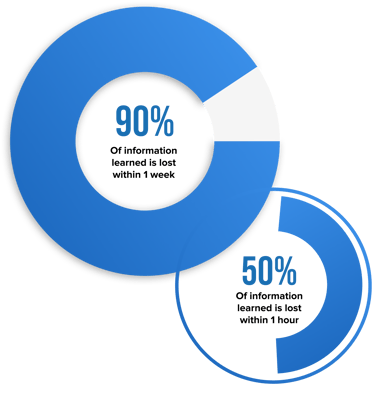
A signature on a policy doesn't mean an officer can remember the specifics during a high-pressure incident. Research on the forgetting curve shows that, without reinforcement, people forget up to 90% of what they were taught within a week. In public safety, the cost of forgetting isn't a failed quiz. It's a use-of-force incident that escalates to internal affairs, or a civil complaint your agency can’t address.
Liability lives in the gap between policy acknowledgment and policy recollection. Microlearning in public safety can close that gap and mitigate risk.
Why traditional policy training gives your agency a false sense of readiness
Nearly every state addressed policing policy in 2024, with more than 1,600 bills introduced at the legislative level. When policies are updated that frequently, one-time acknowledgments don’t keep your workforce up to date.
The standard approach hasn't changed much in decades. Distribute a policy, require a signature, and follow up with a quiz. Acknowledgments are then collected, quiz scores are logged, and your agency has documentation that the policy was received.
But that documentation proves acknowledgment, not comprehension. Some employees skim policies and sign off without fully understanding what changed. Even when officers read an update carefully, it’s unlikely they will retain specifics weeks or months later.
Acknowledgment reports have concerning gaps. They don’t show learning progression or identify knowledge deficits between officers, especially those with different tenures. More importantly, signatures and quiz results don't translate into learning that can be applied in the field.
This gap creates operational risk. An officer who acknowledged a revised use-of-force policy six months ago may not remember the update during a critical incident. The training manager can’t prove the officer truly comprehended the policy—only that it was signed. If a liability claim is made, your agency's defense rests on a signature, not evidence of understanding. The risk of forgotten policies is real, and a signature may not protect your agency.
How microlearning reinforces policy knowledge without pulling officers off the street
Microlearning delivers training in short, focused segments that reinforce specific knowledge over time, rather than covering everything at once. In public safety, that means turning policy content into targeted, repeatable training. Officers can complete it on any device during downtime, between calls, or in the field.
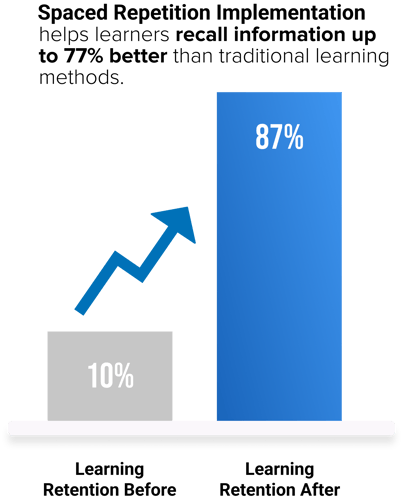 The science behind it is called spaced repetition, a proven learning method. It schedules content review at varying intervals based on how well employees retain information. Content that officers get wrong is prioritized and shown more frequently. Content they've mastered is spaced out. Over time, critical policy knowledge moves from short-term to long-term memory.
That matters in law enforcement more than most fields. High-liability situations like use of force, pursuit driving, and crisis intervention don't happen every day. And their infrequency is what makes retention so difficult. Skills and knowledge that aren't used regularly fade the fastest. Spaced repetition counters that by keeping critical knowledge in active memory. When rare situations do occur, your officers can recall policies instantly and accurately.
It's important to follow policies in public safety, regardless of tenure or experience level. Traditional training treats all officers the same. Microlearning personalizes the experience so each person focuses on what they need most, without pulling them off the street or demanding overtime.
How AI turns your existing policies into microlearning in minutes
Creating policy training from scratch is time-consuming. Training managers are already stretched thin, and manually building quizzes or training materials for every policy update isn't sustainable.
Policy training software like PowerRecall by PowerDMS automates the process. It uses AI to quickly generate digital flashcards from your policies that are already stored in PowerPolicy. Here's how it works.
You select a document or highlight a specific section in PowerPolicy. With the click of a button, AI scans the content and generates flashcards with questions and answers from your policy language, not from external sources. Administrators review, edit, and approve every card before it's published, so nothing reaches your staff without human review.
Flashcards are organized into decks by policy, topic, or role. A use-of-force deck, for example, might draw from your use-of-force policy, reporting requirements, duty to intervene, and medical care obligations. Officers complete the cards on any device using the PowerPolicy mobile app, and the system personalizes reviews based on individual performance.
When a policy changes, Recall automatically pulls related cards into review status and alerts your administrators. They can update the content and republish in minutes, keeping your training current without adding to anyone's workload. Agencies can also attach a Recall deck to a policy assignment in Policy, prompting staff to review the cards before their policy signature is accepted.
Throughout the process, your agency's data stays secure. Documents scanned with AI are protected within PowerPolicy's existing controls. PowerDMS also uses the ChatGPT Enterprise license, meaning your data is never used to train public or global AI models. For a broader look at what this means for your agency, explore smarter AI policy training and a guide to online police training.
From signature to recall score: Proving your officers actually know the policy
Traditional policy acknowledgments give your agency a signature. Microlearning with Recall gives you a recall score – an aggregated numerical score to give clear insight into the retention and learning progress of each learner.
The platform lets administrators see actual policy comprehension across your workforce. Scores can be tracked by deck, officer, or group, making it easy to spot who's struggling with a specific topic and monitor improvement over time. Thanks to report scheduling, leadership can stay informed via email without logging in.
Recall makes remedial training more targeted. Rather than requiring an officer to repeat a broad training program, admins can create a deck for the relevant policy or topic, assign it to that officer, and track their progress over time. The result is a documented record of focused intervention, not a one-size-fits-all response.
Recall analytics also change how your agency responds to scrutiny. In a liability claim, your defense isn't "they signed the policy." Instead, it's documented evidence that the officer was trained, retained the content, and improved over time. In an accreditation assessment, you can pull reports showing policy comprehension across your workforce.
The benefits extend beyond building a defense. With AI-powered card generation, training managers save hours on content creation, which lets them prioritize hands-on police training that can't be completed online. For officers, building long-term policy knowledge translates to better decision-making and compliance in the field.
How to add microlearning to your agency’s existing policy platform
If your agency already uses PowerPolicy, Recall is a direct add-on—no separate system, document uploads, or new logins required.
Start with one of your highest-liability policies, like evidence handling, and generate flashcards with AI. Once reviewed and approved, you can assign the training to relevant officers. From there, Recall can be used to:
- Prepare officers for promotional exams with targeted, role-specific content
- Onboard officers into specialty units like SWAT, K9, and crisis negotiation
- Reinforce key topics from shift briefings
- Provide remedial training for individual officers or small groups
In each case, training reaches officers in a format that works for them. Flashcards are quick, mobile-friendly, and built for the way public safety professionals operate.
Recall brings AI-powered microlearning into the platform your agency already uses. It empowers officers to serve with excellence and gives your agency a better defense. Ready to go beyond the signature?
Book a demo today to see how Recall can protect your people, your community, and your agency.