There is one rotating weekend schedule in public safety that has become extremely common. It is known as the Pitman Schedule.
Article Highlights
- How does the Pitman Schedule work?
- Examples of Pitman Schedule rotation templates
- Pros and cons of the Pitman Schedule
In 24-hour public safety agencies, strategic thinking is a requirement when it comes to personnel scheduling. There are a variety of 24x7 public safety shift schedule template rotations agencies can choose from based on their specific needs, preferences, and other factors.
But one rotating weekend schedule in public safety that has become extremely common. It is known as the Pitman Schedule (or the Pittman Schedule). Let's explore how it works.
How does the Pitman Schedule work?
The Pitman Schedule provides 24-hour coverage by rotating 4 shifts and squads.
The biggest advantage is that each squad has every other weekend off. It’s even common for departments to refer to the rotation as "every other weekend off."
Having every other weekend off makes it a favorable choice for both management and those working the rotation. The rotation is commonly set up for employees to work two-on, two-off; three-on, two-off; two-on, three-off.
The most frequent configuration we have seen of the Pitman is 4 squads/crews, working 2-week templates of either day or night shifts to cover the clock. Two of the crews will have night shifts while the other two have day shifts. All 12 hour shifts.
Examples of Pitman Schedule rotation templates
Below is an example of what the rotation would look like as templates:
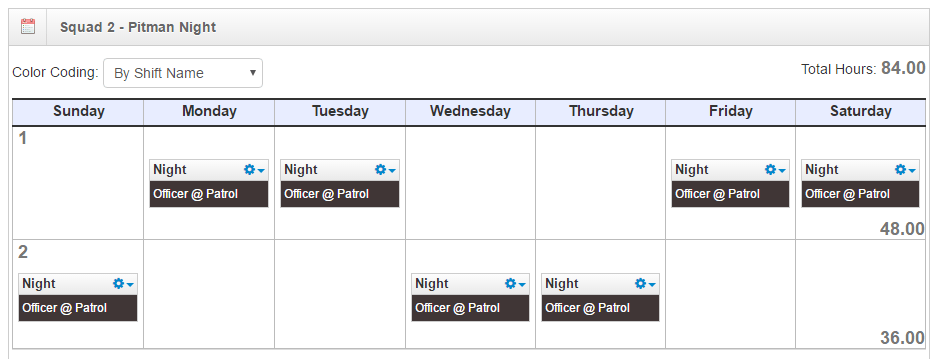
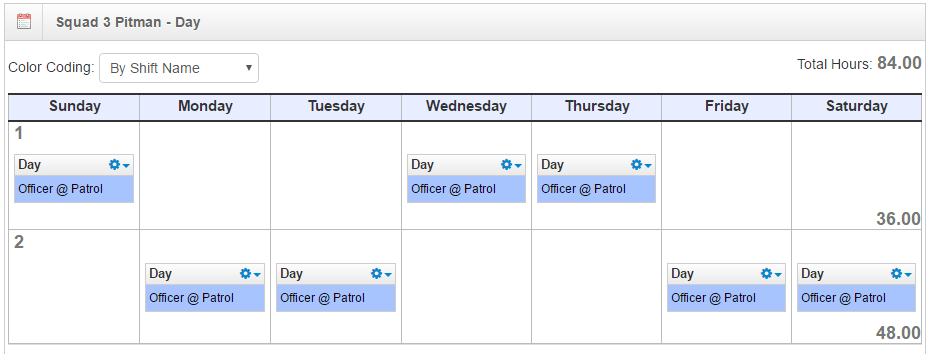
Pros and cons of the Pitman Schedule
While this is a common and efficient way to schedule, it is not a perfect solution. There are some problems. Evaluate the positive and negative aspects of this 12-hour shift schedule carefully before implementation.
Pros
- No employee works more than 3 consecutive days
- 3-day weekends, every other week
- If an employee takes 2 vacation days on one of the 2-day work weeks, they get 7 days’ off
- Work days = approx. 15 days a month, 182 days a year (not including time off, personal, etc.)
- If switching between night and day shift on 4-week rotation, you have a 3-day break prior to the switch... more time off
- Kelly time accumulation to use later - approx. 104 hours a year
Cons
- Long 12-hour work days
- If you are also rotating shifts instead of making shifts permanent, it can be tough for employees to adjust
- Hard on employee's health
- Depending on type of work that arises, may be exhausting some days more so than others
The Pitman Schedule is common in mid-large sized departments that need total coverage with limited staff. Agencies looking to evaluate it for your department to see if it could save you time and money should consider: Will your officers enjoy the long breaks? Or will they get discouraged with 12-hour days? For successful implementation of a new schedule, it is important to keep communication open.
Simplify your shift scheduling
Are you looking for ways to make your shift schedule management process easier? Explore how PowerTime scheduling software for public safety can handle 24x7 schedules, such as the Pitman, with ease – all while saving your department time and headaches.